A clear, flexible film looks like the simplest product in wound care, and it is one of the most misunderstood. A polyurethane (PU) film dressing does not absorb fluid or treat a wound. It manages the space above the wound: what leaves, what stays out, and how comfortably it sits on the skin.
Key takeaways
- A film dressing controls water vapor, not liquid. Its job is to avoid two extremes: fluid pooling under the film and a wound drying out.
- In one laboratory study of PU membranes, a mid-range permeability of about 2,000 g/m²/24 h performed best in a mouse model; very low and very high values did worse.
- Film suits shallow, low-exudate wounds, closed incisions and IV sites. It is not designed for heavily weeping wounds.
- Adhesive-related skin injury is often linked to how a dressing is applied and removed, so technique matters as much as the material.
What a PU film wound dressing is
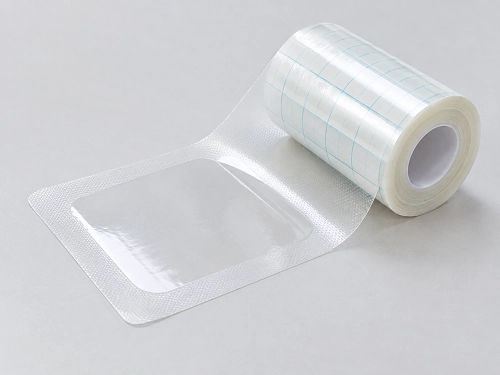
A PU film dressing is a thin, transparent sheet of polyurethane coated on one side with a skin-contact adhesive, most often a medical acrylic. Finished dressings are supplied on a release liner, and many carry a stiffer carrier frame that keeps the thin film flat while it is placed. FULUO’s PU film adhesive roll material follows this pattern: transparent PU film, medical acrylic adhesive, a PET support film, a release liner and an optional insert strip for S-cut converting.
Three properties define the product. The film is liquid-proof, so water and splashes stay outside. It is vapor-permeable, so moisture can escape from beneath it. And it is transparent and elastic, so the site can be inspected without lifting the dressing and the film follows skin movement over joints. Because there is no absorbent core, film is a protective cover rather than a fluid-handling dressing. That single fact explains most of the guidance below.
FULUO’s Polyurethane Wound Dressing and Transparent Film Dressing pages list standard sizes from 6 × 7 cm to 10 × 30 cm, and note that specifications and packaging can be customized.
Moisture is the real specification
Healing tissue does best in a moist, not wet, environment. Too little vapor loss and exudate accumulates under the film. Too much and the wound surface dries. The measurement that describes this is the moisture vapor transmission rate (MVTR), also called water vapor transmission rate (WVTR), expressed in grams of water per square meter per 24 hours.
A 2016 study in Scientific Reports made PU membranes with graded permeability and tested them in cell culture and in a mouse wound model. The medium-permeability membrane, at about 2,028 g/m²/24 h, kept moisture at a level that supported skin cells and fibroblasts and gave the best healing. The researchers reported that an extremely high rate may dehydrate a wound, while an unacceptably low one may let exudate accumulate. It is a laboratory study of research membranes, not a clinical trial of commercial dressings, so it shows the principle rather than a number to specify.
| Reference point | Rate | What it tells us |
|---|---|---|
| Intact skin | about 240–1,920 | Normal water loss through healthy skin |
| Open wound | about 4,800 | An unprotected wound loses far more water than intact skin |
| Study membrane, extremely high | ≈4,026 | Healed less well than the mid-range membrane (mouse model) |
| Study membrane, high | ≈3,282 | Healed less well than the mid-range membrane (mouse model) |
| Study membrane, medium | ≈2,028 | Best result in cell culture and in the mouse wound model |
| Study membrane, low | ≈955 | Too little vapor loss; exudate can accumulate |
| Four commercial film dressings, one supplier’s lab | about 64–1,482 | Wide spread; films were 1.5–2 mil thick and tested by one method |
A number without a method is not a specification
The spread in the last row of Table 1 is the practical lesson. Four commercial film dressings measured by a polymer supplier ranged from roughly 64 to 1,482 g/m²/24 h. Published comparisons also distinguish between a cup test where the dressing faces vapor only (upright) and one where it contacts liquid water (inverted), and the two can give different results for the same dressing. So when you compare products, ask four questions: which test method, at what temperature and humidity gradient, on the film alone or on the finished dressing, and at what film thickness. FULUO’s own PU film roll guide gives the same advice: confirm figures against the supplier’s current data sheet rather than assuming a general range.
The reference rows also explain why there is no single ideal value. An open wound loses far more water than intact skin, so the right dressing depends on how wet the wound is. Use the model below to see the trade-off.
Try it: change the dressing’s MVTR
Illustration only. Values come from the membranes in reference. Real dressings differ in design and test method, and this is not clinical advice.
What “waterproof” and “barrier” really mean
An intact film blocks liquid water and microorganisms from outside. That barrier is only as good as the seal: lifted edges, wrinkles and fluid trapped beneath it all weaken it. FULUO’s product pages describe the film as waterproof, breathable and low-allergy; in practical terms, read that as a protective cover that works while it stays dry, flat and attached.
Hospital guidance reflects this. The US Centers for Disease Control and Prevention (CDC) accepts either sterile gauze or a sterile, transparent, semipermeable dressing over an intravascular catheter site. It says to change the dressing if it becomes damp, loosened or visibly soiled, to use gauze while a patient is sweating heavily or a site is bleeding or oozing, and to replace transparent dressings on short-term central venous catheter sites at least every 7 days, with an exception where dislodging a pediatric catheter is the greater risk. The same guideline says not to submerge a catheter or its site in water. Waterproof is not the same as submersible.
The CDC’s evidence review also notes that it is unknown whether different standard transparent dressings change the risk of catheter-related infection. A transparent film is therefore a sound, accepted option, but it is not proof of lower infection risk by itself. Good technique and timely changes carry much of the benefit.
Where PU film fits, and where it does not
FULUO’s product pages list the following uses for film dressings: abrasions and lacerations, superficial and partial-thickness burns, post-surgical dressings, I.V. catheter sites, securing or covering devices, and use as a secondary dressing over hydrogels, alginates and gauze. Film is generally associated with shallow wounds that produce little fluid. The same pages advise against using it on infected wounds unless a healthcare provider directs it, and against heavy bleeding or heavily exuding wounds.
| Dressing type | Exudate it suits | Main strength | Main limitation | FULUO page |
|---|---|---|---|---|
| PU or transparent film | None to low; film does not absorb | Waterproof at the surface, see-through, flexible, low profile | Fluid pools if the wound weeps | Transparent Film Dressing |
| Foam | Low to heavy, depending on the product | Absorbs and cushions | Opaque and thicker; the wound cannot be seen | Foam Wound Dressing |
| Hydrocolloid | Low to moderate | Self-adhesive and forms a gel over the wound | Opaque; a gel residue is normal on removal | Hydrocolloid Wound Dressing |
| Non-woven island | Low | Soft, breathable and economical for minor wounds | Needs changing once the pad is saturated | Non-woven Wound Dressing |
Table 2 is a general orientation, not a prescription. Always follow the instructions for use of the specific product and the advice of a clinician. For a wound that produces more fluid than film can handle, compare a foam, hydrocolloid or alginate dressing, with film as an outer cover if appropriate. For catheter securement, FULUO also makes a dedicated cannula fixation dressing.
Applying, wearing and removing it
Most problems with film dressings trace back to the skin underneath and the way the adhesive is applied or removed. The steps below combine FULUO’s instructions for use with the adhesive-injury consensus guidance.
- Prepare the skin. Clean the area as advised, then let it dry completely. Applying an adhesive over skin prep that has not dried increases the risk of skin injury.
- Choose a size with a margin. The dressing should be slightly larger than the wound so the adhesive sits on intact skin all the way round.
- Place it without stretching. Remove the liner without touching the adhesive, lay the film on, and smooth it from the center outward. Stretching the film during placement can irritate the skin.
- Check the seal. Look for wrinkles, trapped air and lifted corners, and press the edges down.
- Know when to change it. FULUO’s instructions suggest every 2–5 days or as medically advised, and sooner if the dressing is saturated or peeling. For catheter sites, follow the CDC intervals above.
- Remove it slowly. Lift one edge and pull the film back along the skin at a low angle, supporting the skin with your other hand. If it resists, loosen it with saline or an adhesive remover instead of pulling.
The animation below shows the placement sequence from liner to finished dressing, then what the film does once it is on.
Simplified, not to scale. The animation repeats automatically every ten seconds.
Why removal technique deserves attention
Medical adhesive-related skin injury (MARSI) is skin damage caused by adhesive products. A widely used definition counts redness or another skin change that persists 30 minutes or more after the adhesive is removed. The 2013 consensus, written by a panel of 23 experts, called it a prevalent but under-recognized complication across all care settings and age groups. A 2024 update reached the same conclusion about under-recognition. In the interest of transparency, the 2013 summit was supported by an unrestricted educational grant from 3M, and the update is summarized here through a manufacturer’s brochure, so read the journal articles for the full text.
If you see lasting redness, blistering or tearing after a dressing comes off, stop using that product on the area, protect the skin and ask a clinician about alternatives.
For OEM and private-label buyers
Behind every finished film dressing is a roll of coated material. FULUO Medical has made medical adhesive materials, tapes and wound dressings since 2007 in Zhejiang, China, and handles adhesive coating, slitting, converting and finished-product packaging in one place. Its manufacturing page lists three production lines covering sports tape, medical tape and wound dressings, and a 500 m² GMP 100,000-class workshop. Its quality control team works from two independent laboratories and more than 10 full-time inspectors who carry out microbiological testing, environmental monitoring and physical and chemical performance testing.
Whichever supplier you use, these are the questions worth putting in writing before you order samples:
- MVTR: which method, at what conditions, and is the figure for the film or the finished dressing?
- Film thickness and elongation, since these affect conformability over joints.
- Adhesive type and peel adhesion, matched to the intended wear time and skin type.
- Liner design, for example an S-cut liner for one-handed application, and any grid or logo printing.
- Biocompatibility and regulatory documentation for your target market, not just the material description.
- Lot-level quality records and how coat-weight uniformity is monitored, because uneven adhesive creates weak points during die cutting.
You can browse the full medical roll materials range, read about OEM and customization options, or contact the team for data sheets and samples. For finished products, start at the wound care dressing category.
Frequently asked questions
Can I shower with a PU film dressing on?
Usually yes, provided the edges are fully sealed, because the film is waterproof at the surface. Avoid soaking or submerging the area, and replace the dressing if water gets underneath or it loosens.
How long can a film dressing stay on?
It depends on the wound, the site and the product. FULUO’s instructions suggest 2–5 days unless advised otherwise, and sooner if the dressing is saturated or lifting. Catheter dressings follow clinical protocols.
Can film be used on an infected wound?
Not unless a healthcare provider directs it. Watch for redness, swelling, pus or increasing pain, and seek medical advice if you see them.
Is PU film the same as foam or hydrocolloid?
No. Film has no absorbent layer, while foam and hydrocolloid dressings are built to manage fluid. See Table 2.
What if my skin is red after the dressing is removed?
Mild, brief redness can be normal. Redness or other changes that last 30 minutes or more can indicate adhesive-related skin injury. Stop using that product on the area and ask a clinician.